
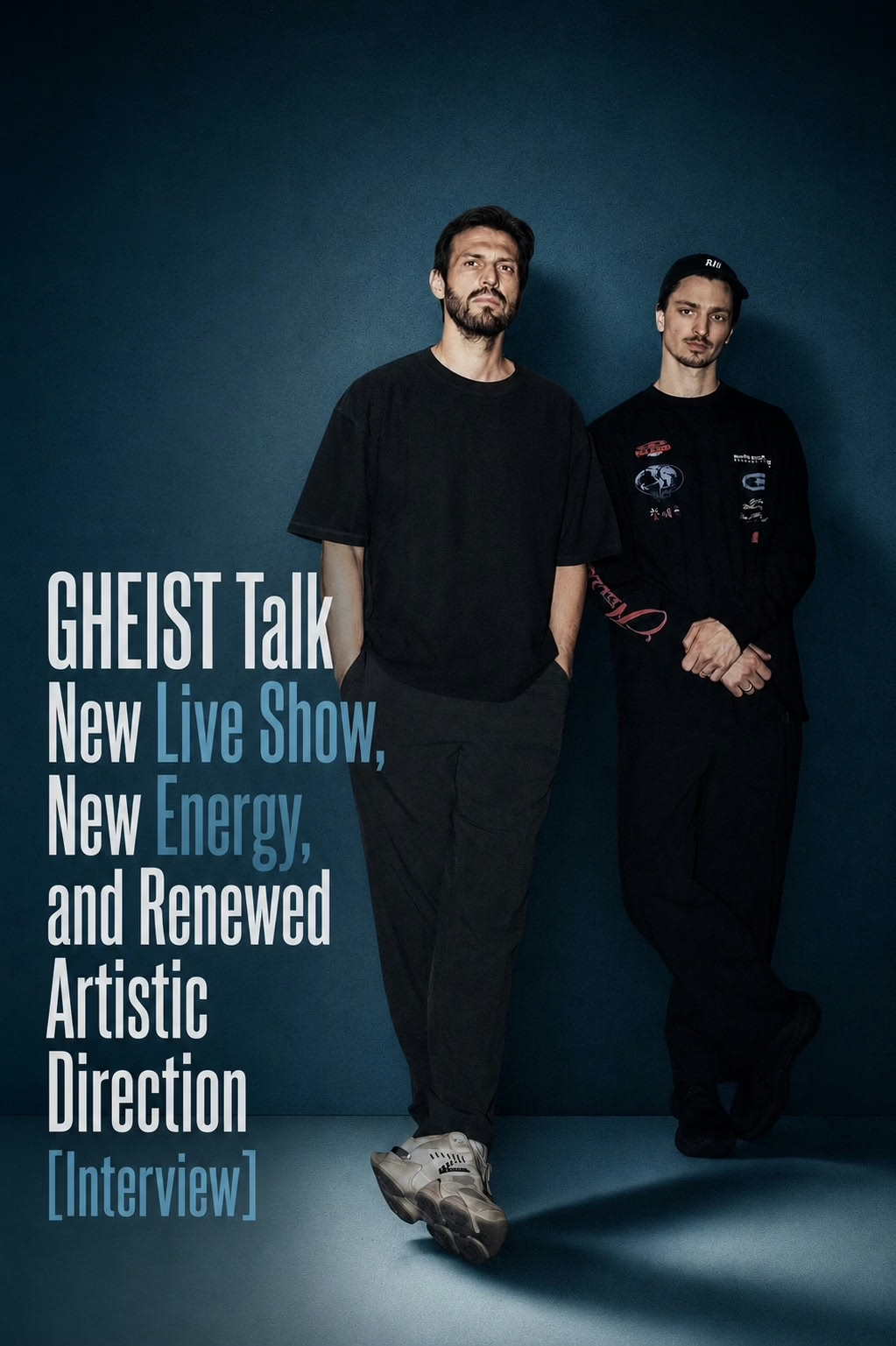
Regular readers will know that here at EKM, we are big fans of GHEIST, the Berlin-based collective best known for tracks like Frequent Tendencies, Marimba, and I Am Human. Today we are lucky enough to be bringing you an interview with the House music titans, talking about their new House single GHEIST – Paradise on Embassy One and their new live setup, amongst other topics.
Inside the House Pulse of GHEIST – Paradise
With their new track Paradise, GHEIST deliver a release that feels both familiar and refreshingly different. The band’s trademark melodic sensibilities remain intact, but the single also leans into a more immediate and physical energy, driven by a rolling House groove, an insistent bassline and a memorable lead synth riff. The track thrives on momentum, constantly shifting and evolving while maintaining a hypnotic sense of forward motion.
The single also serves as an introduction to a new phase for GHEIST. Alongside the release, the Berlin outfit have unveiled a reworked live setup centered around founding member Stefan and vocalist, songwriter and frontman Ramon. The refreshed format places greater emphasis on live performance and spontaneity, allowing the music to develop more organically in the moment rather than following a strictly predetermined structure. As you can read in our interview with GHEIST below, this mirrors the creative philosophy behind Paradise itself.
Furthermore, whilst the collective remain rooted in House music, there is also growing sense that the project is moving beyond rigid genre classifications in favor of something more fluid. Their new House track Paradise on Embassy One is indeed a reflection of this, bringing the emotional depth that fans have come to expect from GHEIST, but also embracing a freer and more adventurous musical direction, as outlined in the interview below. In this sense, as both a standalone release and a fresh statement of intent, Paradise suggests that GHEIST are entering an exciting new chapter defined by reinvention, live energy, and a willingness to follow their creativity wherever it may take them.
In Conversation With GHEIST About Paradise, Embassy One and Their New Live Show
This new chapter for GHEIST seems to come from a very real turning point rather than a planned rebrand. When Filou stepped away from touring for health reasons, how did that moment change the way you looked at the future of the project?
It forced us to pause for a moment and ask some fundamental questions about where we wanted to take the project next. After years of touring, releasing music, and constantly moving forward, it felt like the right time to take a step back and look at GHEIST from a wider perspective.
What became exciting very quickly wasn’t the idea of replacing something, but the opportunity to rethink certain aspects of the project and explore new possibilities creatively. We found ourselves talking more about the live experience, the connection between music and visuals, and how we wanted people to feel when they come to a GHEIST show.
Looking back, that period gave us the space to become very intentional about the future. A lot of the music, the live setup, and the energy people are seeing now grew out of those conversations.
Instead of continuing on autopilot, you took time to step back and reassess. What did that period of reflection reveal about what GHEIST still needed to be, and what it no longer needed to be?
That period created a lot of clarity for us. We realised that some of the most important things in music are often the easiest to lose sight of: curiosity, excitement, and the simple joy of creating something together.
At the same time, we felt that certain things had become more complicated than they needed to be. Too much overthinking, too many expectations, and too much focus on where things were supposed to go next rather than enjoying the process itself.
The reflection phase helped us reconnect with that mindset. A lot of the music that followed came from a much more instinctive place, and that energy naturally found its way into the studio, the live show, and everything around it.
Ramon now takes on a more central role as frontman. How has his presence changed the emotional dynamic of the live show and the way GHEIST connects with an audience?
One of the biggest changes has been that we no longer think about music purely from a studio perspective. A lot of the new material is written with the live experience in mind from the very beginning. While we’re writing, we’re constantly asking ourselves: would we be excited to play this live? Does it create a moment? Does it move us? Is this something we would genuinely want to experience ourselves on stage and in a room full of people?
That shift naturally influences everything from songwriting to arrangement and production. We still care deeply about atmosphere and emotion, but we’re also looking for a certain physical energy and immediacy that comes alive in a live environment.
Working closely with Ramon has been an important part of that process. The collaboration naturally encouraged us to think more about performance, interaction, and how the music evolves once it leaves the studio and becomes a shared experience.
You rebuilt the live setup almost from the ground up. What did you want this new version of the show to feel like physically, emotionally, and visually?
From there, everything else followed. The music, the way we perform it, the energy we wanted to create in a room, and the connection we wanted to build with an audience. Rather than thinking about what a GHEIST show had been, we focused on what we wanted it to become.
At the same time, we became increasingly excited by the idea of creating the kind of moments that we would want to experience ourselves at a club or festival.
A lot of the new music was written specifically with clubs, festivals, and live performance in mind. How does writing for the stage from the very beginning change the creative process in the studio?
The creative spark itself hasn’t really changed. Songs can still start from a melody, a chord progression, a vocal idea, or simply a moment of inspiration. Sometimes that comes from another piece of music, sometimes from a film, a conversation, a place, or even a sound you unexpectedly encounter in everyday life.
What has changed is that we think much earlier about where that idea might lead. Instead of keeping it inside the studio, we start imagining how it could translate into our live environment, how it might evolve on stage, and whether it’s the kind of moment we would want to experience ourselves in a club or at a festival.
Those questions often influence the arrangement, the dynamics, and sometimes even the direction a song takes long before it’s finished.
“Good Life” felt introspective and transitional, while “Paradise” introduces a more playful, open, and euphoric energy. Do those two tracks represent different stages of the evolution you have been going through?
In some ways, yes, but probably not in a linear sense. We don’t really see those tracks as different stages leading from one thing to another. They’re more like different facets of the same period and the same creative journey.
“Good Life” carries a certain sense of reflection and perspective, while “Paradise” explores a more playful and spontaneous energy. Both songs came from the same mindset, but they express it in very different ways.
That’s something we love about writing music. Not every idea wants to become the same kind of record. Some songs naturally become deeper and more reflective, others feel lighter, more direct, or more euphoric. Part of the journey is figuring out what a song wants to become.
GHEIST has always balanced melancholic atmosphere with club-focused energy. As the project moves into this more physical and movement-driven phase, how do you preserve that emotional depth?
For us, emotional depth comes from creating music that reflects something real.
Over the years, we’ve realised that not every song needs to look backwards. A lot of the new music is inspired by what lies ahead rather than what has already happened. Instead of writing about things we’re trying to process, we’re increasingly drawn towards ideas, feelings and possibilities that excite us about the future.
At the same time, we’ve found ourselves reconnecting with the roots that brought us into electronic music in the first place. House and Techno have always been at the core of GHEIST, and there’s something beautiful about music that doesn’t need to be overly complicated to create a powerful feeling. We’re increasingly drawn to that sense of simplicity, movement and shared energy that sits at the heart of great dance music.
In many ways, every song starts as a vision of something that doesn’t exist yet. A feeling, an experience, a place, or a moment we’re imagining. The creative process is about giving that idea a shape. And once the music is released, that vision is no longer imaginary. It becomes something real that can be shared, experienced and lived by other people as well.
You have released music through labels such as Watergate, Anjunadeep, Diynamic, Rose Avenue, Last Night On Earth, and Exploited, while also building RADAU Records. How important is independence and creative control in this next phase?
For us, it’s never really been a question of independence versus collaboration. Some of our favorite releases happened in partnership with great labels, and those relationships have played an important role in the journey of GHEIST.
What’s important is finding the right home for the music and working with people who genuinely understand what you’re trying to build.
RADAU grew out of that same idea. It gives us the freedom to release music on our own terms when it makes sense, while remaining open to whatever path feels right for a particular record. We don’t see those things as opposites. The goal has always been to create the best possible environment for our music.
The new chapter feels very instinctive and organic rather than forced. Was there a specific moment in the studio or during rehearsals when you realized, “This is the new GHEIST”?
We never really felt like we were creating a new version of GHEIST.
For us, it felt more like following a natural creative progression. The excitement of creating new ideas, building a live show, and imagining where those songs could take us.
As the music started to come together and the live set began to take shape, there was a growing sense of momentum around everything we were doing. Things felt natural, ideas were flowing, and every step seemed to point in the same direction.
More than anything, it felt like things falling into place.
Looking ahead, what do you want audiences to feel when they experience this rebuilt GHEIST live show for the first time?
The best live experiences stay with you long after the lights go on. Not because of a particular moment in the set, but because of how they make you feel.
We’ve always been drawn to those kinds of experiences ourselves. The ones you keep talking about on the way home, the next day, or sometimes even years later.
Those are the moments we’re chasing.
Where to stream GHEIST – Paradise?
Where to stream GHEIST‘s Top Tracks?
Follow GHEIST
RA | Instagram | Facebook | Spotify | Soundcloud | Beatport
Follow Embassy One
Facebook | Instagram | Soundcloud | Spotify | Beatport | Website